FOR MEN WHO LIFT AND ARE ON A GLP-1
Lose the fat. Keep the strength you spent years building.
The drug handles the appetite. It does nothing for the muscle underneath. That part needs a plan.
45 minutes. We look at your numbers. You find out if this fits.
45 minutes. We look at your numbers. You find out if this fits.
You didn't build it to lose it.
Years of sessions went into that frame. The drug will strip the fat in months. The question nobody asked before the first shot: what else comes off with it?
Up to 40% of the weight lost on these drugs can be lean mass. Not fat. The chest, the arms, the legs you paid for rep by rep. The scale reads the same either way. It adds fat and muscle together and hands you one number.
Your bench knows. Your deadlift knows. Pull up your log from three months ago and look at the top set.
The difference is a protocol, not willpower.
In one study, 200 people on GLP-1s paired the drug with resistance training and individualized protein targets. Six months later: 13% of body weight lost, 3% of muscle lost.
The default, no protocol: up to 40% of the loss coming off as lean mass.
Same drug. Different system.
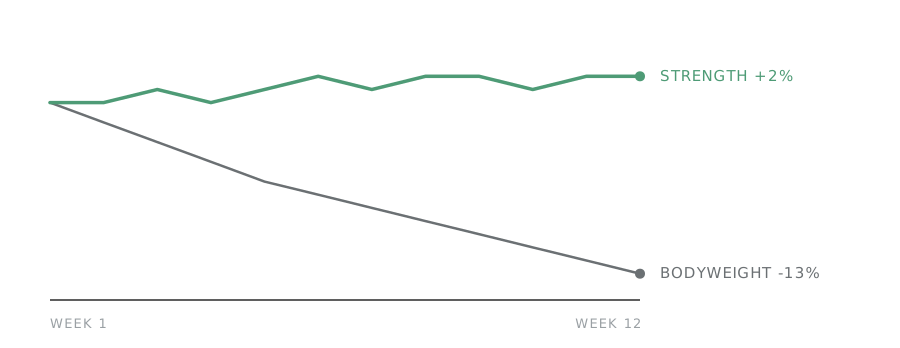
Illustrative. Both lines indexed to week one, because kilos of bodyweight and kilos on the bar aren't the same quantity and don't share a raw axis.
THE SCOREBOARD
Strength is the scoreboard, and we read it every week.
Bench, squat, deadlift, body fat, protein hit rate, sessions completed. The numbers go in weekly and a coach looks at them. If a lift drops two weeks running, the plan changes that week, not next quarter.
THE FOOD PLAN
Built for a body that isn't hungry.
Most cut plans assume you'll eat when you're told. On a GLP-1 that assumption breaks. The food plan is engineered around low appetite. Protein-dense, small volume, timed to the windows when you can actually eat.
The problem was never your discipline. It's that nobody wrote you a plan for a day where food is the last thing you want.
THE OFF-RAMP
You keep it when you come off.
Most people regain most of the weight within a year of stopping, because the drug ends and nothing was built to replace it. We build the training and eating habits that hold when the prescription ends, on the timeline you and your prescriber set.
The system is the deliverable. The coaching is how you install it.
Who's behind this
Alex [surname]. [One or two lines of real credentials: years lifting, coaching background, why he built this.]
He built this protocol for one guy: the former athlete who got busy, got on the jab, and refused to watch fifteen years disappear with the fat.

What you actually get.
A training plan, a food plan, and a coach who reads your numbers every week. That's the whole offer.
Three lifts a week, your protein hit every day, including the days food is the last thing you want, and measurements every two weeks so you can see fat leaving and muscle staying. If that sounds like work, it is. It's also the whole job.
This isn't for you if
You're not training. We're the training and food layer, so there needs to be something to build on.
You want the fastest possible number on the scale. We'll cost you some of that speed on purpose.
You want someone to talk to you about your dose. That's your prescriber's job and we won't go near it.
You're looking for a four-week thing. The point is what's left standing at month twelve.
Every week on the drug without a plan is muscle you don't get back.
45 minutes. We'll look at what you're lifting, what you're eating, and where the gap between them is. You'll leave knowing whether this fits, either way.
We're not a clinic and we don't prescribe. Your prescriber handles the medication. We handle the training, the food and the tracking that sit around it.